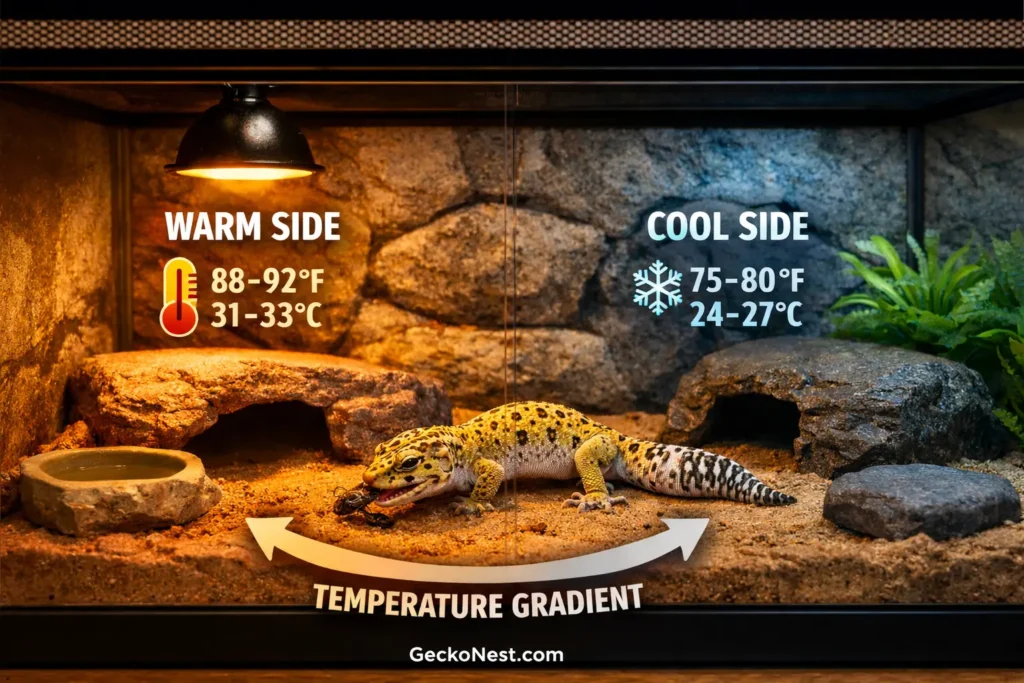

At first glance, the whole gecko vs lizard debate can feel a bit silly. After all, both are scaly, both have tails, and both occasionally freeze in place like they’ve just remembered they left the oven on. So… aren’t geckos just lizards?
Well—yes. But also no. And that’s where things get interesting.
A gecko is technically a type of lizard, but not all lizards are geckos. It’s the same logic as “every square is a rectangle, but not every rectangle is a square.” (Math teachers everywhere just nodded proudly.)
Still, geckos have several unique traits that make them wildly different from the average lizard people imagine. Their sticky feet, giant eyes, nighttime habits, vocal sounds, and climbing abilities set them apart in ways that surprise even longtime reptile fans.
In this guide, we’ll break down the real difference between gecko and lizard species, explain why people confuse them so often, and show you exactly what makes geckos one of the weirdest—and coolest—branches of the reptile family tree.
Is a Gecko a Lizard? (Yes… But It’s More Complicated Than That)
The short answer is yes: geckos are lizards.
Scientifically, geckos belong to the reptile order Squamata, the same large group that includes all lizards and snakes. Within that group, geckos form their own specialized branch known as Gekkota.
So if you’ve ever asked:
- “Is a gecko a lizard?”
- “Are geckos and lizards the same thing?”
- “What is the difference between a gecko and a lizard?”
…the answer is this:
A gecko is a specific kind of lizard with unique adaptations that separate it from most other lizard groups.
Think of it like this:
- Lizard = broad category
- Gecko = specialized subgroup within that category
So saying “gecko vs lizard” is technically like saying “SUV vs car.” One is a subtype of the other—but the differences still matter.
Want to explore reptile taxonomy in more detail? Britannica’s reptile classification guide explains how lizards and geckos are scientifically grouped.
Gecko vs Lizard – Quick Comparison Table
| Feature | Gecko | Typical Lizard |
|---|---|---|
| Classification | Subgroup of lizards | Broad reptile category |
| Feet | Sticky toe pads (many species) | Clawed feet |
| Eyes | Large, night-adapted | Smaller, day-adapted |
| Eyelids | Usually none | Usually present |
| Sound | Vocal / chirping | Mostly silent |
| Activity | Often nocturnal | Often diurnal |
| Climbing | Excellent climbers | Varies widely |
| Skin | Softer/finer scales | Often rougher |
| Tail Defense | Common tail drop | Also possible, but varies |
| Pet Popularity | Very high | Depends on species |
11 Major Differences Between a Gecko and a Lizard
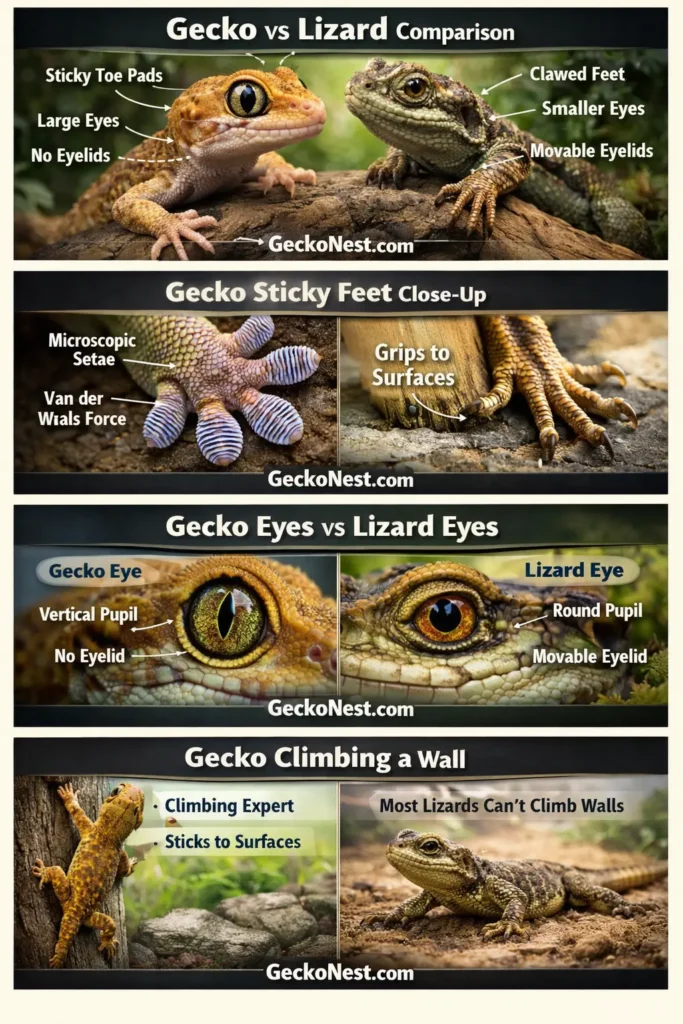
1. Gecko Feet Are Basically Nature’s Super Glue
The biggest and most obvious difference in the gecko vs lizard comparison is the feet.
Many geckos have specialized adhesive toe pads covered in microscopic hairs called setae. These structures let them stick to:
- Glass
- Walls
- Ceilings
- Probably your dignity if one jumps on your face unexpectedly
Most regular lizards do not have this ability.
Their feet rely on claws for grip, not molecular wizardry.
2. Geckos Have Massive Eyes Built for Night Vision
Most geckos are nocturnal, so they evolved huge eyes relative to their head size.
These eyes help them hunt in low light and give them that permanently surprised expression—like they just found out mealworms aren’t unlimited.
Most non-gecko lizards:
- Have smaller eyes
- Are active during daytime
- Depend less on night vision
3. Most Geckos Don’t Have Eyelids
One of the weirdest gecko vs lizard differences:
Most geckos lack movable eyelids.
Instead, they have a transparent protective membrane over their eyes… and they clean it by licking their eyeballs.
Yes.
They lick their eyes.
Nature saw windshield wipers and said, “Nah, tongue is fine.”
Most lizards, by contrast, have normal eyelids they can blink with.
4. Geckos Are Surprisingly Chatty
Unlike many lizards, geckos can be very vocal.
Depending on species, geckos may:
- Chirp
- Bark
- Squeak
- Click
- Make tiny angry dinosaur noises
Most lizards are relatively quiet.
So if your reptile is making noise at 2 AM like a haunted rubber duck, odds are… it’s a gecko.
5. Gecko Skin Usually Feels Softer
Another subtle but noticeable difference between gecko and lizard species is skin texture.
Geckos often have:
- Softer, velvety skin
- Finer scales
- Delicate texture
Many other lizards have:
- Rougher scales
- Thicker armored skin
- More rigid texture
This is especially noticeable in pet species like leopard geckos versus bearded dragons.
6. Geckos Are Elite Climbers
Because of their adhesive feet and lightweight bodies, geckos dominate vertical surfaces.
Many can scale:
- Glass terrariums
- Painted walls
- Tree bark
- Smooth ceilings
Most lizards cannot.
They climb well on rough surfaces perhaps—but smooth glass? Not happening.
7. Geckos Are More Often Nocturnal
Most geckos are active at night.
Most common lizards people know (bearded dragons, iguanas, many skinks) are active during the day.
This affects everything from:
- Eye shape
- Hunting behavior
- Sleep patterns
- Care requirements for pets
8. Gecko Tails Are Famous for Emergency Escape Mode
Yes, many lizards can drop their tails.
But geckos are especially known for it.
When threatened:
Tail detaches
Tail wiggles dramatically
Predator distracted
Gecko runs away like it just committed tax fraud
Tail-dropping is common in geckos and one of their signature defenses.
9. Gecko Toes Are Structurally Unique
Under magnification, gecko toes look like something from science fiction.
Their adhesive system uses van der Waals forces—tiny molecular attractions between surfaces.
That means:
Geckos do NOT use slime or suction.
They stick through pure physics.
Basically tiny reptile Spider-Men.
10. Their Body Shape Often Differs
Compared to many standard lizards, geckos tend to have:
- Shorter snouts
- Wider heads
- Chunkier eyes
- Compact bodies
Other lizards may appear:
- Longer
- More streamlined
- More dragon-like
This isn’t universal, but it’s a common trend.
11. Gecko Care Is Often Different From Other Lizards
In the pet world, gecko vs lizard matters a lot.
- More humidity (species dependent)
- Different climbing setups
- Different supplements
- Specialized enclosure designs
A leopard gecko setup is extremely different from a bearded dragon setup.
Treating “all lizards the same” is one of the fastest ways to accidentally create a reptile complaint department.
Why Do Geckos Stick to Walls?

Because science is weird and amazing.
Gecko toe pads contain millions of microscopic hairs.
Each hair splits into even smaller tips that interact with surfaces through van der Waals forces.
In plain English:
Their feet create molecular-level attraction with surfaces.
No glue.
No suction.
No magic.
Just absurdly advanced biology.
That’s why geckos can walk on ceilings like rent is due.
Want to learn more about how geckos stick to walls? Wikipedia explains the specialized toe pads and adhesive structures that allow geckos to climb smooth surfaces.
Are Geckos Better Pets Than Other Lizards?
That depends what you want.
For Beginners
Geckos—especially leopard geckos—are often easier for beginners.
Why?
- Smaller enclosures
- Simpler diet
- Easier handling
- Lower intimidation factor
“Hello friend.”
A 5-foot iguana says:
“This enclosure belongs to me now.”
For Display Tanks
Crested geckos and day geckos make incredible display animals because they:
- Climb constantly
- Use vertical space
- Are visually striking
For Handling
Some larger lizards tolerate handling better than tiny geckos.
It varies heavily by species.
Common Myths About Geckos and Lizards
“Geckos and Lizards Are Completely Different Animals”
False.
Geckos are lizards.
They’re just a special subgroup.
“All Lizards Can Climb Walls”
False.
Most cannot.
Your bearded dragon is not secretly Spider-Man.
“Geckos Are Poisonous”
False.
Pet geckos are harmless.
They may judge you silently, but they won’t poison you.
“All House Lizards Are Geckos”
Not necessarily.
Many house-climbing reptiles are geckos, but identification depends on region.
Which Is More Common in Homes Worldwide?
Wild geckos are among the most common reptiles found in homes globally.
Why?
Because they love:
- Warm walls
- Outdoor lights
- Insects gathering near bulbs
So if you see a tiny lizard on your wall at night:
It’s probably a gecko.
Final Verdict: Gecko vs Lizard – What’s the Real Difference?
Here’s the simplest way to understand it:
All geckos are lizards, but not all lizards are geckos.
Geckos stand out because they typically have:
- Sticky feet
- Giant eyes
- No eyelids
- Vocal sounds
- Better climbing ability
- Nocturnal behavior
So while geckos technically belong to the lizard family, they’re specialized enough that most people naturally separate them in conversation.
And honestly?
Fair enough.
A creature that can lick its eyeballs and run upside down on your ceiling has earned the right to feel a little different.
The biggest point in the gecko vs lizard comparison is that a gecko is a special type of lizard with unique traits like sticky toe pads, large eyes, and often no movable eyelids. While all geckos are lizards, not all lizards are geckos.
Not exactly. A gecko vs lizard article compares a gecko, which is one branch of the lizard family, with the broader lizard group. It helps explain why geckos look and behave differently from many other common lizards.
Yes, geckos are technically lizards. The gecko vs lizard question usually comes from the fact that geckos have very distinct features, so people often assume they are a completely separate animal group.
People search for gecko vs lizard because geckos look, move, and behave differently from many other lizards. Their wall-climbing ability, eye shape, vocal sounds, and nighttime habits make them stand out immediately.
Yes, feet are one of the most interesting parts of the gecko vs lizard comparison. Many geckos have adhesive toe pads that help them climb walls and ceilings, while most lizards rely more on claws and surface grip.
Absolutely. In the gecko vs lizard comparison, geckos often have larger eyes adapted for low-light conditions, while many other lizards are more active in daylight and have eye shapes that suit daytime hunting.
In most cases, yes. The gecko vs lizard comparison usually highlights climbing ability because many geckos can scale smooth vertical surfaces, something that most other lizards cannot do nearly as well.
Yes, the gecko vs lizard topic matters a lot for pet owners because care needs can be very different depending on the species. Enclosure size, humidity, diet, climbing space, and handling tolerance may vary widely.
In the gecko vs lizard comparison, geckos are more commonly nocturnal. Many species are active at night and have physical adaptations that help them move, hunt, and navigate in low-light environments.
The gecko vs lizard comparison is interesting because it shows how one subgroup within the lizard family evolved some very unusual features. Sticky feet, vocal sounds, eyelid differences, and climbing skill make geckos especially memorable.







Helpful Leopard Gecko Tools
Quick calculators and practical tools for feeding, humidity, health, and enclosure setup.
Feeding Calculator
Estimate the right feeding amount for your leopard gecko.
Open ToolCalcium & D3 Calculator
Plan calcium and vitamin D3 more easily and accurately.
Open ToolHumidity Checker
Check if your terrarium humidity is in a safe range.
Open ToolHealth Symptom Checker
Review possible health issues based on symptoms.
Open ToolSetup Builder
Build and review the ideal leopard gecko enclosure setup.
Open ToolGecko Age Calculator
Estimate your gecko’s age and life stage.
Open ToolElectricity Cost Calculator
Estimate terrarium electricity costs by day, month, and year.
Open ToolBreeding Compatibility
Check if two leopard geckos are compatible for breeding.
Open ToolPet Name Calculator
Find a fun and fitting name for your leopard gecko.
Open ToolWeekly Care Planner
Create a simple weekly care routine for your gecko.
Open Tool